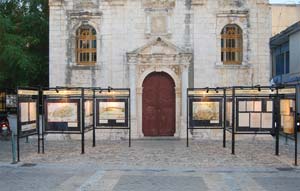


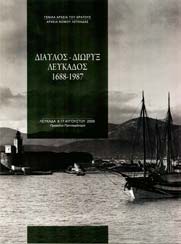
The channel, the narrow and shallow in much of the strait that separates Lefkada from Acarnania starting south from the bay of Drepanou and ending up in the bay of Agios Nikolaos in the north, was in the past an important sea route. The Corinthians in the 7th century BC. They were the first to deepen him to be floating from large ships. Since then, the respective rulers of the island usually made sure that it was kept open.
In 1684 the Venetians took Lefkada from the Turks and moved the capital of the island from the area of the fortress to its current location. Agia Mavra was now far from the port in front of the   fortress; and its inhabitants asked the Venetians to open the channel to transport their goods by boat to and from the city. In 1761, the Venetian administration of the island expressed interest in the opening of the channel and a study was carried out in which its economic importance for the island was recognized. But no work was done.
In 1806, the Ionian Islands decided to open the channel for the additional reason of the defense of Lefkada against Ali Pasha. The unfavorable international treaties, however, did not allow the realization of the project.
The imperial French who controlled Lefkada from 1707 to 1809 expressed the intention of opening the channel recognizing its importance for trade.
In the year 1818 the united state of the Ionian Islands under English “protection” began the work of digging the channel. Emergency taxation for its financing caused a dynamic uprising of the peasants which was suppressed by the English army. The channel opened up to the trench of the fortress and then the “new port” was built in front of the fortress, 1500 meters away from the capital of the island, Agia Mavra. Narrow canal that connected the port with the city and next to it the “Castle Road”. Until 1857 the works were not completed.
When in 1864 the Ionian Islands were united with Greece, the goal of claiming Epirus belonging to the Ottoman Empire and at the same time the needs of local trade and shipping brought back the issue of opening a functional canal. The project was studied by the “French Public Works Mission” in 1889 and began to be implemented in 1898 at the expense mainly of the prefecture of Lefkada through special taxes and secondarily from state credits. First the internal port and the port square were built. Then the two side canals of the city were deepened. The canal, as it is today, the widening of the “Castle Road” to the west and the platform east of it, as well as the ferry to the fortress was completed in 1903. The road that connects the fort with the Akarnan coast It had already been built with embankments on the channel since 1895.
The absence of an integrated road network until about 1960 made the canal the main communication road of the city with the ports of the island, with the ports of the surrounding area and with Piraeus. In 1987 the ferry, the picturesque, slow-moving “Perama” was replaced by the floating bridge.
Today, the canal, in the service of tourism, which forms the basis of the economy of the prefecture of Lefkada, is mainly sailed by pleasure boats.
- Exhibition Duration : 8-17 August 2009
- Venue: Pantokrator Yard